
Environmental pollution has become an urgent global issue. Due to complex pollution sources and monitoring difficulties, current monitoring methods and density are far from meeting practical demands. This poses great obstacles and challenges for researching the impacts of air pollution on human health. Among all types of pollution, air pollution is the most severe, making air quality monitoring particularly crucial.

After experiencing coal-smoke pollution and photochemical smog pollution, we are now facing a new stage dominated by composite atmospheric pollution. Studies have shown that the air contains a large number of organic substances, including carcinogens and harmful pathogens.
Monitoring technology is an essential means for humans to understand and transform the world. Its core lies in the acquisition, transmission and processing of information, for which sensors serve as an indispensable tool.
Air quality sensors integrate microelectronics technology, sensing technology, signal processing technology and other comprehensive technologies. Featuring low hardware cost, compact size, simple software operation and wide application range, they play a vital role in intensive environmental monitoring.
Local emissions and regional pollutant transmission are the main causes of increased pollutant concentrations in fixed areas. Without sophisticated numerical simulation tools, it is extremely difficult to study the health effects of polluted air on the human body. At present, the effective solution is to deploy pollutant monitoring equipment to expand and improve the environmental monitoring network.
Sensor technology has become a mainstream method for air quality monitoring in research and practical application. In the current air monitoring field, the AQMS-09 monitoring device is equipped with multiple built-in sensors, which can simultaneously detect the concentration of PM2.5, PM10, sulfur dioxide (SO₂), nitrogen dioxide (NO₂), carbon monoxide (CO), TVOC and other air pollutants.
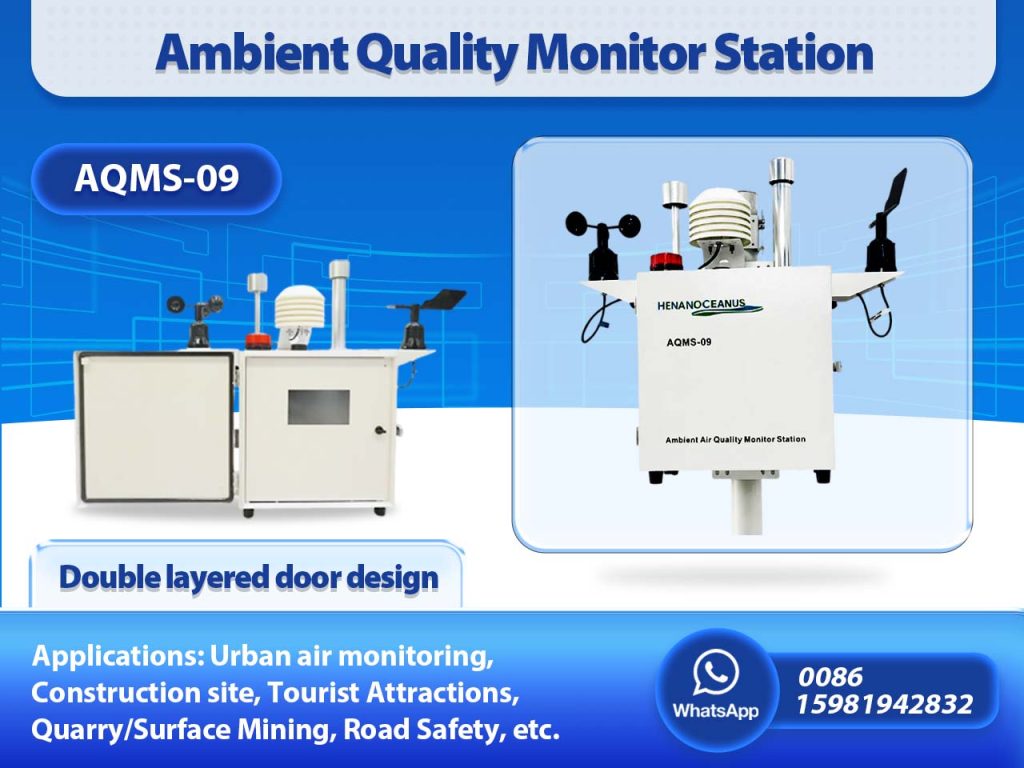
Air quality monitors are indispensable for detecting toxic gases in factories, industrial waste gas and residential ambient air. Only with the support of such monitoring systems can accurate detection be realized and a high-quality living environment be guaranteed. It can be said that air quality monitoring is closely related to everyone’s life and health.
Air quality sensors adopt integrated technologies including microelectronics, sensing and signal processing. They realize minimized hardware cost and volume, along with simple operation and extensive applicability, enabling them to perform monitoring tasks efficiently in industrial sites, public areas and other scenarios.
Installation & Monitoring Point Layout
Monitoring stations shall be arranged in representative areas such as residential communities, industrial zones, traffic trunk lines and ecologically sensitive areas, avoiding shelter or interference from buildings.