
Published on July 28 | World Nature Conservation Day
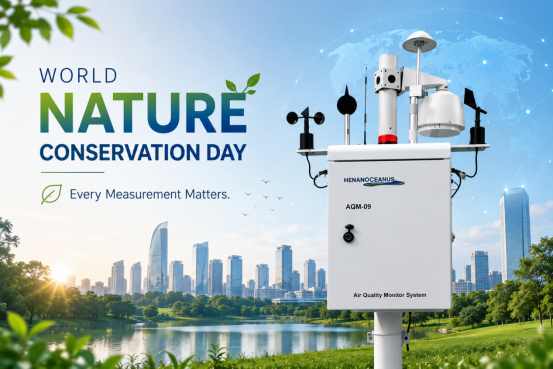
Every year, World Nature Conservation Day reminds us of the importance of preserving the natural world. We often think of forests, oceans, wildlife, and renewable energy when discussing environmental protection. Yet one of the most essential parts of our environment is something we rarely notice—the air around us.
Unlike rivers or mountains, air is invisible. We cannot see it, hold it, or always recognize when it changes. Despite that, it influences every aspect of our daily lives, from public health and urban development to industrial activities and climate resilience.
Protecting nature isn’t only about responding to environmental problems. It also means understanding the changes happening around us before they become visible.
Nature Is Constantly Changing
Our environment is never static.
A warm summer afternoon can trigger higher ozone levels. Strong winds may disperse pollutants in one area while transporting them to another. Construction activities, traffic, seasonal weather, and industrial operations all affect local air quality in different ways.
Many of these changes happen quietly. Without continuous monitoring, they often go unnoticed until their impacts become significant.
This is why environmental monitoring has become an essential part of modern environmental management. It provides a clearer picture of what is happening in real time, helping organizations understand trends rather than relying on assumptions.
Seeing What the Eye Cannot
Technology has given us the ability to observe what was once invisible.
Modern air quality monitoring systems continuously measure key environmental parameters, transforming complex atmospheric conditions into meaningful information.
Instead of asking, “Is today’s air good or bad?”, monitoring allows us to answer more important questions:
- How has air quality changed over the past week?
- Which pollutants are increasing?
- When do pollution levels typically peak?
- How do weather conditions influence local air quality?
Reliable data provides context. And context leads to better decisions.
Data Is Only Valuable When It Leads to Action
Collecting environmental data is not the final goal.
The real value lies in how that information is used.
Governments use monitoring data to evaluate environmental policies. Industrial facilities rely on continuous monitoring to improve operational management. Researchers study long-term trends to better understand environmental change. Communities gain greater awareness of the air they breathe every day.
Every data point contributes to a broader understanding of our environment.
Technology Supporting a More Sustainable Future
As monitoring technologies continue to evolve, environmental observation has become more accessible than ever.
Cloud connectivity, wireless communication, intelligent sensors, solar-powered deployment, and remote data management enable continuous monitoring across cities, industrial facilities, construction sites, ports, and remote locations.
These innovations do more than improve efficiency—they help build a stronger foundation for environmental protection.
Looking Ahead
Nature doesn’t always tell us when something is changing.
Sometimes, the most important environmental changes are completely invisible.
Understanding them requires patience, reliable technology, and continuous observation.
This World Nature Conservation Day, we are reminded that protecting nature begins not only with action, but with awareness.
Because the better we understand our environment, the better we can protect it.
About Oceanus
Oceanus is committed to providing professional environmental monitoring solutions for customers worldwide.
Our portfolio includes ambient air quality monitoring systems, gas detection solutions, and intelligent environmental monitoring technologies designed for urban environments, industrial facilities, construction sites, and other demanding applications.
We believe that accurate environmental data helps people make better decisions, supports sustainable development, and contributes to a healthier future for everyone.