
As global environmental regulations become increasingly stringent, traditional ground-based air quality monitoring alone can no longer meet the demands of high-resolution environmental management. Integrated Air-Ground-Space Monitoring has become one of the most advanced approaches for environmental protection, urban management, and industrial pollution control.
This comprehensive monitoring framework combines satellite remote sensing, airborne monitoring platforms, unmanned aerial vehicles (UAVs), and ground-based air quality monitoring stations to provide multi-dimensional environmental data. Among these technologies, ground-based air quality monitors serve as the foundation of the entire monitoring network, delivering accurate, real-time, and legally reliable environmental data.
Without precise ground monitoring, satellite and aerial observations can only provide pollution trends rather than quantitative measurements for environmental assessment and regulatory enforcement.
How the Integrated Air-Ground-Space Monitoring System Works?
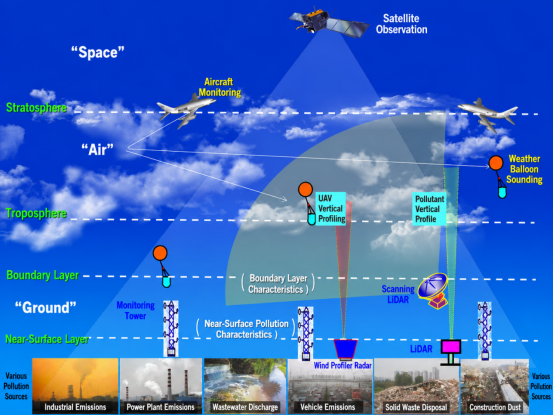
Air-Ground-Space Integrated Monitoring is an advanced environmental monitoring framework that combines satellite remote sensing, airborne monitoring platforms, and ground-based monitoring equipment into one coordinated system.
Unlike conventional monitoring methods, this multi-dimensional approach enables environmental agencies to monitor atmospheric pollution from regional trends down to street-level air quality, providing comprehensive environmental intelligence for pollution prevention and regulatory compliance.
- Satellite monitoring for large-scale pollution observation. Satellite remote sensing provides continuous observation over large geographical areas, helping identify regional pollution transport, aerosol distribution, and atmospheric changes.
- Airborne/UAV monitoring for rapid pollution source identification. Aircraft and UAVs perform flexible inspections, collect vertical atmospheric profiles, and rapidly locate pollution sources that cannot be observed from the ground.
- Ground air quality monitoring for high-precision validation and continuous measurement. Ground monitoring stations continuously measure pollutant concentrations and meteorological parameters, providing accurate reference data for satellite calibration and environmental assessment.
This coordinated approach enables governments and environmental agencies to detect pollution sources more efficiently while improving the accuracy of atmospheric environmental management.
Why Ground Air Quality Monitoring Is Essential
1. Provides Accurate Calibration Data
Satellite and airborne monitoring estimate pollution conditions over large areas, while ground-based air quality monitors deliver precise pollutant concentrations that serve as the reference standard for environmental evaluation and regulatory enforcement.
2. Complements Remote Sensing
Remote sensing technologies have limitations in spatial resolution and cannot detect every local pollution event.
Ground monitoring captures:
- Street-level pollution
- Industrial emissions
- Construction dust
- Localized pollution fluctuations
This significantly improves monitoring accuracy.
3. Supports Multi-Platform Data Integration
Modern air quality monitoring equipment supports deployment across multiple platforms, including:
- Fixed monitoring stations
- Vehicle-mounted systems
- UAV monitoring platforms
- Portable monitoring devices
Unified data management allows seamless integration of environmental information from space, air, and ground.
4. Enables Scientific Environmental Management
Continuous environmental data helps governments and enterprises:
- Track pollution trends
- Evaluate emission reduction performance
- Identify pollution sources
- Develop targeted environmental policies
- Improve urban air quality management
Reliable monitoring data forms the basis for evidence-based environmental decision-making.
Satellite remote sensing can identify pollution over large areas, but cannot accurately measure pollutant concentrations at breathing height. UAVs provide flexible inspections but are designed for temporary monitoring missions. Continuous, high-precision ground monitoring remains essential for environmental management.
As the core of the Air-Ground-Space monitoring network, reliable ground monitoring equipment determines the overall accuracy of environmental data.
Oceanus Air Quality Monitoring Solutions
Oceanus provides professional ambient air quality monitoring systems that complement satellite and UAV monitoring by delivering continuous, high-precision environmental measurements.Oceanus offers a complete range of air quality monitoring solutions for different environmental applications.
Typical Applications in Ground Layer Monitoring
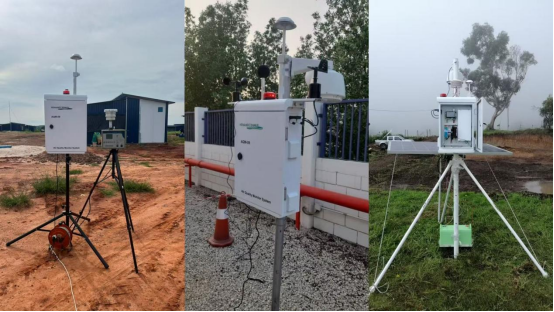
As the ground layer of an Integrated Air-Ground-Space Monitoring Network, Oceanus air quality monitoring systems provide continuous, high-precision environmental data that complements satellite remote sensing and UAV monitoring. Our solutions have been widely deployed in a variety of environmental monitoring projects, including:
- AQM-09 Air Quality Monitor System – Installed in communities, roadsides, campuses, and industrial facilities to monitor real-time ambient air quality. It supports long-term environmental monitoring by collecting accurate data on PM, gaseous pollutants, and weather conditions at breathing height.
- AQMS-09 Ambient Air Quality Monitoring Station – Used as a fixed ground monitoring station in urban air quality networks, industrial parks, environmental protection projects, and smart city monitoring systems. It continuously measures particulate matter, gaseous pollutants, and meteorological parameters, providing reliable reference data for satellite calibration and environmental assessment.
- OC-9200 Online Dust Monitor System – Applied at construction sites, mining areas, ports, cement plants, and waste treatment facilities to continuously monitor dust emissions and meteorological conditions, helping ensure compliance with environmental regulations.
Together, these ground monitoring solutions form the essential foundation of an Air-Ground-Space Integrated Monitoring Network, enabling governments, environmental agencies, and industrial enterprises to achieve accurate pollution assessment, early warning, and scientific environmental management.
In a modern smart city, satellite remote sensing first identifies regional pollution trends. UAVs are then deployed to investigate potential emission sources, while Oceanus AQM-09 continuously monitors pollutant concentrations and meteorological parameters at ground level.
Why Choose Oceanus?
Oceanus has extensive experience in developing environmental monitoring equipment and provides reliable solutions for customers worldwide.
Our advantages include:
- High-precision imported sensors
- Modular design with customizable monitoring parameters
- 24/7 continuous online monitoring
- Remote data transmission and cloud platform integration
- Easy installation and reliable outdoor performance
Build a Smarter Monitoring Network with Oceanus
Whether you are developing an urban air quality monitoring network, an industrial environmental monitoring project, or a smart city platform, Oceanus provides reliable monitoring solutions tailored to your needs.
Contact our team today to learn how Oceanus Air Quality Monitoring Systems can support your environmental monitoring project.