
Odor complaints, ammonia emissions and hydrogen sulfide are common concerns in landfills and poultry farms. Although these gases may not always be visible, they can indicate changes in waste decomposition, manure management, ventilation and overall environmental conditions.
For operators and environmental teams, portable gas monitoring provides a practical way to identify abnormal gas concentrations, investigate odor sources and perform routine inspections.
Where Do H₂S and NH₃ Come From?
Hydrogen sulfide (H₂S) and ammonia (NH₃) are commonly associated with the decomposition of organic materials.
In landfills, organic waste can generate malodorous gases during decomposition. H₂S may be present around waste handling, leachate and other areas where organic material breaks down under low-oxygen conditions.
In poultry farms, ammonia is strongly associated with poultry manure. Poor ventilation, manure accumulation and high humidity can contribute to increased ammonia levels inside or around livestock buildings. H₂S and other odor-producing compounds may also occur as organic waste decomposes.
This makes H₂S and NH₃ useful parameters for routine environmental and workplace inspections.
Why Monitor Odor in Addition to H₂S and NH₃?
Odor is not always caused by a single gas.
A landfill or poultry farm can release a mixture of gases and volatile compounds, meaning that measuring only one gas may not provide a complete picture of an odor problem.
Odor monitoring can therefore be used alongside H₂S and NH₃ measurements to help teams:
- Investigate odor complaints
- Identify potential emission sources
- Compare different monitoring locations
- Check ventilation conditions
- Support environmental inspections
- Record changes during waste or manure management activities
The goal is not simply to obtain a single gas reading, but to understand how gas concentrations change across different areas and operating conditions.
Landfill Gas Monitoring: What Should Be Checked?
Landfill monitoring can involve different areas depending on the purpose of the inspection.
Typical monitoring points may include waste handling areas, transfer zones, leachate-related areas, site boundaries and other locations where unusual odors have been reported.
Portable equipment is particularly useful when operators need to move between multiple points rather than relying only on permanently installed sensors.
A practical monitoring process can include:
1. Establish monitoring points
Select locations based on site layout, complaints, operating activities and potential emission sources.
2. Measure H₂S and NH₃
Record gas concentrations at different locations and operating conditions.
3. Check odor conditions
Compare odor readings with gas concentration data where appropriate.
4. Record and compare results
Use stored data to identify abnormal areas or changes over time.
Poultry Farm Monitoring: From Manure to Ventilation
Poultry houses can have changing gas conditions depending on ventilation, manure accumulation, humidity and animal activity.
Ammonia is one of the key gases that operators may monitor in poultry production environments. H₂S and other odor-related gases can also be relevant when investigating manure decomposition and odor emissions.
Portable monitoring allows personnel to inspect different areas instead of relying on measurements from a single fixed location.
For example, measurements can be taken near:
- Poultry houses
- Manure storage areas
- Waste collection points
- Ventilation outlets
- Areas with reported odor problems
By comparing measurements from different locations, operators can gain a clearer understanding of where abnormal concentrations or odor conditions may occur.
What Should You Look for in a Portable Gas Detector?
For landfill and poultry farm applications, a useful portable gas detector should be more than a simple concentration display.
Several functions can make field inspections more practical:
Multi-Gas Detection
Different applications require different gas combinations. A configurable detector can be adapted for H₂S, NH₃, odor, TVOC and other parameters according to the monitoring task.
Pump-Suction Sampling
Active sampling allows the instrument to draw air into the detection chamber through a sampling line. This can be useful when checking specific locations that are difficult or inconvenient to access directly.
Real-Time Display and Alarm
A clear display allows operators to view gas concentrations during inspection, while audible, visual and vibration alarms can provide immediate notification when preset thresholds are reached.
Data Storage
For routine inspections, recorded measurements can help teams compare different monitoring locations and maintain measurement records for later analysis.
Oceanus Solution for H₂S, NH₃ and Odor Monitoring
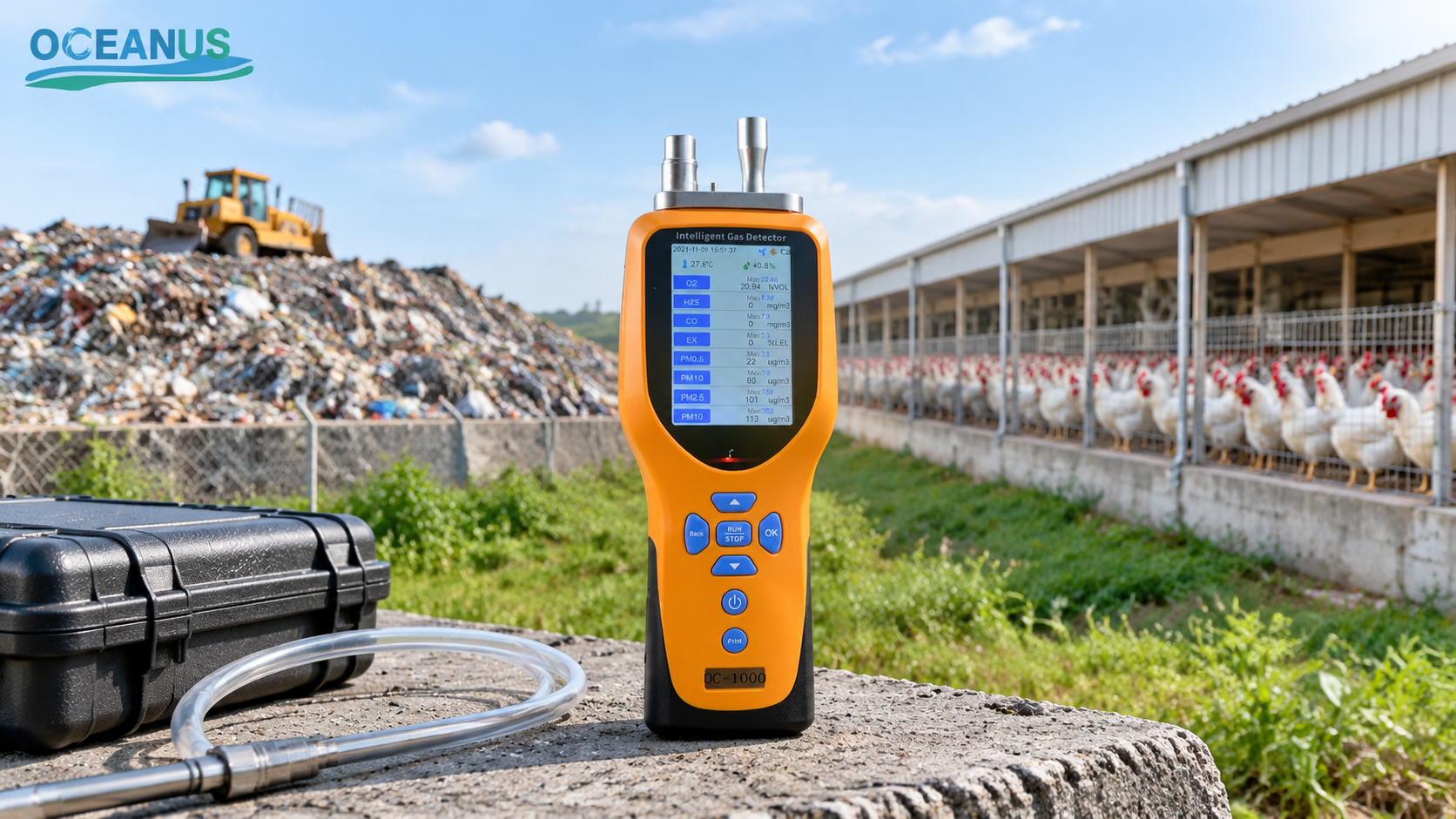
For applications requiring odor, H₂S and NH₃ measurements, the Oceanus OC-1000 can be configured as a multi-parameter portable gas analyzer.
The Oceanus OC-1000 supports detection of odor gas, NH₃, H₂S and TVOC, with pump-suction sampling. Its configuration can also be customized according to different monitoring requirements. The instrument provides real-time concentration display, audible/visual/vibration alarms and large-capacity data storage for field inspections.
For applications primarily focused on H₂S and NH₃, the Oceanus OC-850 provides a more focused solution. It supports H₂S and NH₃ detection, with both diffusion and optional pump-suction sampling, making it suitable for livestock farms, landfill-related inspections, sewage environments and other malodor monitoring applications.
You can explore more Oceanus portable gas detection solutions here:
Oceanus Portable Gas Detectors
From Gas Detection to Better Environmental Management
H₂S, NH₃ and odor monitoring should not be viewed only as a response to complaints.
Regular measurements can help environmental teams understand changing conditions, identify potential problem areas and make more informed decisions about ventilation, waste management and site inspection.
Whether the application is a landfill, poultry farm, wastewater facility or another organic-waste environment, the right portable monitoring solution can make field inspection more flexible and data-driven.
If you are looking for a portable gas detector for H₂S, NH₃, odor or multi-gas monitoring, Oceanus can provide configurable solutions based on your target gases, measuring ranges and sampling requirements.
Whatsapp: +86 15981942832
Email: info@china-oceanus.com